
University Disciplines in Algeria: Current Trends and Future Prospects
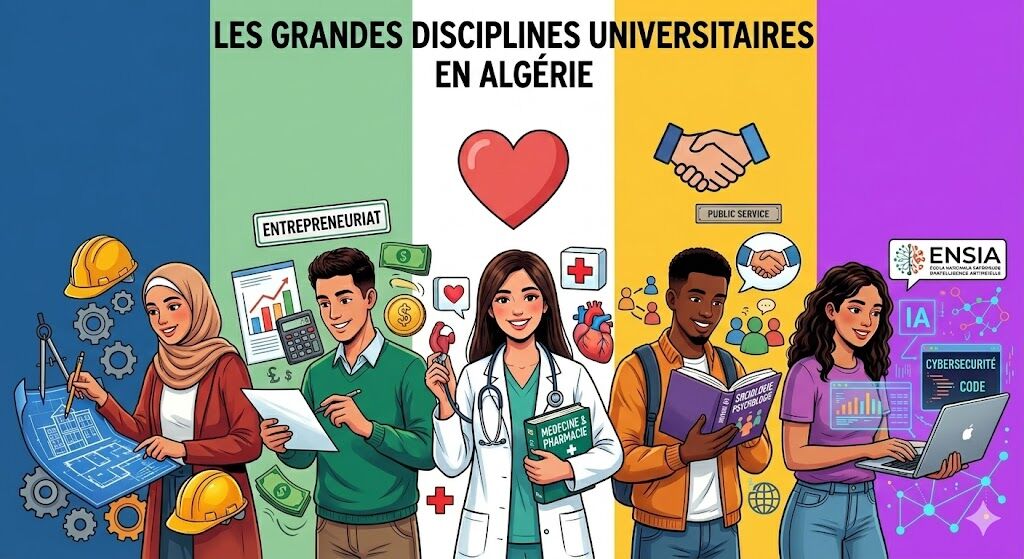
Following the release of the Baccalaureate results in Algeria, graduates were quickly faced with the critical task of choosing a university discipline. This choice depends on several factors, particularly those related to contemporary challenges and the career opportunities offered by the modern job market. Here is an overview of the most popular disciplines in higher education institutions in Algeria.
1. Engineering Sciences
Disciplines related to engineering sciences, especially civil, mechanical, electrical, and computer engineering, are among the most sought-after by Algerian students. This trend is largely due to the growing demand for qualified professionals to support the country’s infrastructural and technological development. Algeria is investing heavily in modernizing its infrastructure, and engineers play a crucial role in these ambitious projects.
2. Economics and Management Sciences
Economics and management sciences also attract a large number of students. Programs in economics, business administration, accounting, and finance are particularly popular. This demand is fueled in particular by the growth of entrepreneurship in the country, as well as the need to improve business efficiency and develop the private sector. Students are preparing to meet the challenges of globalization and economic competitiveness.
3. Medical and Health Sciences
Medical disciplines, such as medicine, pharmacy, and nursing, are consistently at the top of the list. Algeria trains a significant number of doctors each year through its faculty of medicine programs. Due to the high quality of training and professional stability, the medical sector is attracting a growing number of students. Training in these fields aims to prepare professionals capable of meeting the increasing needs for healthcare and contributing to improving the living conditions of citizens.
4. Humanities and Social Sciences
Disciplines in the social sciences and humanities, particularly psychology, sociology, and political science, are also popular. These programs attract students who want to work in administrative positions and join the civil service. They play a vital role in analyzing societal issues and formulating public policies tailored to local Algerian realities.
5. Information Science and Technology
Information and communication technologies (ICTs) are experiencing rapid growth and constant evolution. Indeed, a large number of students are choosing disciplines such as information systems, cybersecurity, and artificial intelligence. This trend is largely influenced by the increasing digitization of economic sectors and the need to train experts capable of supporting this digital transition. In this context, the National School of Artificial Intelligence (ENSIA) opened its doors in 2021 after its creation by presidential decree. This institution’s primary objective is to train a highly qualified elite in AI professions.
Finally, the choice of academic disciplines in Algeria reflects the country’s needs and aspirations in the face of contemporary challenges and future opportunities. While engineering and economics still dominate the academic landscape, fields such as ICT and AI are showing significant growth momentum. Higher education in Algeria continues to evolve, adapting to economic and technological transformations to prepare students for a promising and successful future.